



What Are Polycarbonate Roof Screws?
Polycarbonate roof screws are fastening systems designed to secure polycarbonate roofing sheets to supporting structures such as timber battens, steel purlins, or other compatible framing systems. Unlike ordinary construction screws, roofing fasteners used with polycarbonate generally need to address two issues at the same time: mechanical attachment and controlled movement of the plastic sheet.
Polycarbonate is a durable and impact-resistant roofing material, but it also expands and contracts as temperatures change. Because of this movement, a fixing system that clamps the sheet too tightly may create unnecessary stress around the screw hole. A suitable polycarbonate roofing fastener should hold the panel securely without preventing normal thermal movement.
Many purpose-designed polycarbonate roof screws are paired with weather-resistant sealing washers. EPDM is a common washer material because it can create a resilient seal around the fixing point when properly installed. Some specialized systems also incorporate an expansion-hole cutting feature so the fastener can create additional clearance around the screw shaft while being installed.
Why Standard Screws May Not Be Enough
A conventional wood or metal screw may physically attach a roofing panel, but that does not mean it is suitable for long-term polycarbonate installation. If the hole is too tight, the sheet may not have enough clearance to move. If the washer is too small or unsuitable for outdoor exposure, water may eventually enter around the fixing point. If the fastener has insufficient corrosion resistance, the roof may develop staining, corrosion, or premature fastening failure.
Key point: The best polycarbonate roof screws are not simply the strongest screws available. They must match the panel profile, support material, environmental conditions, and movement requirements of the roofing system.
Where Are Polycarbonate Roof Screws Used?
Polycarbonate roofing panels are used in many residential, commercial, agricultural, and light-industrial structures. Because the framing system and panel profile vary between applications, screw selection should be based on the actual project rather than choosing one universal fastener.
- Patios and pergolas: Clear or tinted roofing panels are commonly installed over outdoor entertaining areas.
- Carports: Polycarbonate roofing provides daylight while protecting vehicles from rain and direct weather exposure.
- Greenhouses: Roofing fasteners must secure panels while accommodating temperature-related movement.
- Walkways and canopies: Corrugated or structured panels are often used for weather protection.
- Awnings: Lightweight polycarbonate panels can be installed over windows, entrances, and commercial storefronts.
- Industrial daylight roofing: Polycarbonate sheets may be incorporated into larger roofing assemblies to introduce natural light.
- Agricultural structures: Sheds, growing areas, and covered work zones may also use polycarbonate roofing systems.
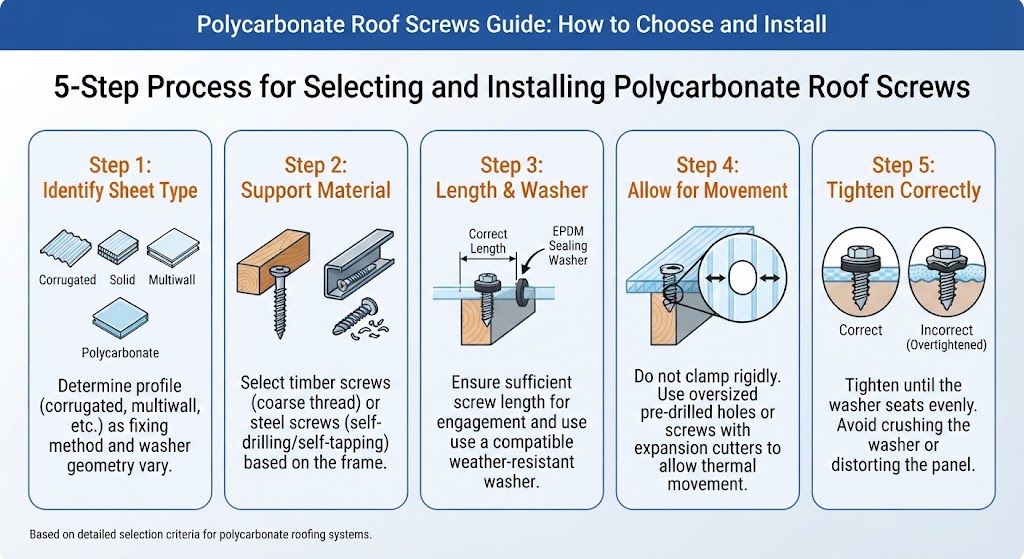
5-Step Process for Selecting and Installing Polycarbonate Roof Screws
The most reliable way to choose fasteners is to work from the roofing system backward. Start with the sheet profile and frame material, then determine the screw configuration, washer, length, and installation method.
Step 1: Identify the Polycarbonate Sheet Type
Determine whether the project uses corrugated, trapezoidal, solid, or multiwall polycarbonate. The fixing point, washer geometry, profile height, and support method may differ depending on the sheet. Do not assume that a screw used for one panel profile will automatically suit another.
Step 2: Identify the Support Material
Timber and steel framing require different fastener characteristics. Timber screws usually rely on coarse threads and a point suited to wood penetration, while steel applications may require self-drilling or self-tapping fasteners designed for the thickness of the metal purlin.
Step 3: Select the Correct Length and Washer System
Screw length must account for the roofing profile, washer or spacer arrangement, and sufficient engagement into the supporting structure. A screw that is too short may not achieve reliable holding strength, while an unnecessarily long fastener may leave excessive exposed thread or interfere with the structure below.
Step 4: Allow for Sheet Movement
Polycarbonate should not be fixed as though it were rigid sheet metal. Depending on the roofing system, installation may involve oversized pre-drilled holes or purpose-designed fasteners that create expansion clearance. The objective is to let the sheet move without concentrating excessive stress around the fixing. Manufacturer-specific installation instructions should take priority because hole size and fixing details vary by panel system.
Step 5: Tighten the Fastener Correctly
Tighten the screw until the sealing washer seats evenly against the roofing surface. Do not continue driving until the washer is excessively flattened or forced outward. Washer compression, fastener angle, sheet profile, and installation quality all influence weather sealing performance.
How to Choose Polycarbonate Roof Screws: 6 Key Checks
1. Match the Screw to Timber or Metal Framing
The first purchasing mistake is choosing a screw based only on its overall appearance. A timber screw and a self-drilling steel screw may look similar from a distance, but their point geometry and thread design are intended for different substrates. Always specify the support material when requesting a quotation.
2. Check the Washer Material and Diameter
The sealing washer is a critical part of the fastening system. It distributes pressure around the fixing point and helps prevent water penetration. EPDM is widely used for outdoor roofing seals because it can remain flexible and weather-resistant when properly specified.
3. Confirm the Screw Length
Screw length should be selected according to the roof profile and the required engagement into the support. Corrugated sheets often require a longer fastener than flat panels because the screw must pass through the crest before reaching the purlin or batten.
4. Check Corrosion Resistance
Roofing fasteners remain exposed to moisture, condensation, UV radiation, airborne contaminants, and changing temperatures. For coastal, industrial, or high-humidity environments, corrosion resistance becomes particularly important. Stainless steel or appropriately coated fasteners may be considered depending on the project specification and compatibility requirements.
5. Check Whether Expansion Clearance Is Built Into the System
Some polycarbonate roofing screws incorporate a cutter that creates clearance around the fastener as the screw passes through the sheet. Other roofing systems require separate pre-drilling. Buyers should know which method is expected before ordering because the installation procedure changes accordingly. Purpose-designed fasteners with expansion-hole cutters are commercially available for both timber and metal applications.
6. Confirm Compatibility With the Roofing Manufacturer
The safest approach is to compare the fastener specification with the installation guide supplied for the polycarbonate sheet. Panel profile, thickness, purlin spacing, local wind conditions, structural design, and roof geometry can all influence fixing requirements. A generic recommendation should never override the roof-sheet manufacturer's installation specification or applicable building requirements.
What Affects Polycarbonate Roof Screw Cost?
There is no single universal price for polycarbonate roof screws. Two fasteners of similar size can have very different specifications, coatings, washer systems, packaging quantities, and performance characteristics. For contractors, distributors, and project buyers, comparing only the unit price can therefore be misleading.
| Cost Factor | Why It Matters | What Buyers Should Confirm |
|---|---|---|
| Screw Material | Different steels, stainless grades, and protective finishes have different manufacturing costs. | Material grade and coating specification. |
| Washer System | Large sealing washers, domed washers, and specialized assemblies may cost more than basic washers. | Washer material, diameter, and geometry. |
| Length and Diameter | Longer or heavier fasteners use more material and may require different manufacturing processes. | Actual project dimensions rather than approximate size. |
| Expansion-Hole Feature | Specialized cutters or wings add functionality and manufacturing complexity. | Whether the installer will pre-drill or use a self-clearancing fixing system. |
| Corrosion Protection | Higher-performance coatings or stainless materials may increase initial cost. | Exposure environment and expected service conditions. |
| Order Quantity | Bulk cartons, wholesale orders, and project quantities may use different pricing structures. | Required quantity plus reasonable site allowance. |
When requesting a quote, buyers should compare specifications on a like-for-like basis. A lower-priced screw with a smaller washer, unsuitable coating, or incorrect drill point may not be equivalent to a fastener designed specifically for polycarbonate roofing.
Timber vs. Steel Frames: Which Screw Type Should You Use?
Polycarbonate Roof Screws for Timber
Timber applications generally use screws with a point and thread geometry designed to bite securely into wood. A coarse thread is commonly associated with timber fastening because it provides good engagement in the wood fibers. Some purpose-designed polycarbonate roofing screws use a Type 17-style point for timber applications.
Polycarbonate Roof Screws for Steel
Steel purlins normally require a fastener that can drill or tap into the metal substrate. The correct drill point depends on the steel thickness and the fastener manufacturer's specification. Using a drill point intended for thin sheet steel on a much thicker support can create installation problems, while an unnecessarily aggressive point may also be inappropriate for light-gauge framing.
Procurement tip: Always include the purlin material and approximate thickness when requesting polycarbonate roof screws. “Roofing screw” alone is not enough information for an accurate recommendation.
Common Installation Mistakes to Avoid
1. Overtightening the Screw
Driving the fastener too tightly can excessively compress the washer and restrict panel movement. It may also deform the profile around the fixing point. The washer should create a weather seal without being crushed.
2. Making the Screw Hole Too Tight
Polycarbonate moves with temperature. A hole that closely grips the fastener shaft may prevent movement and concentrate stress around the hole. Many installation systems therefore use oversized holes or specialized expansion-hole cutters.
3. Using the Wrong Washer
A washer that is too small, poorly supported, or unsuitable for outdoor exposure may not provide the intended seal. The washer should be compatible with the fastener head, panel profile, and expected weather exposure.
4. Driving Screws at an Angle
An angled fastener can make the washer contact the sheet unevenly. This may reduce sealing performance and place uneven pressure on the panel. Keep the fastener aligned correctly with the fixing surface.
5. Ignoring the Roofing Profile
Corrugated roofing, trapezoidal roofing, and flat or multiwall sheets do not necessarily use identical fixing arrangements. Follow the panel manufacturer's designated fixing location rather than assuming every roof should be screwed through the same part of the profile.
6. Using Indoor-Grade or Low-Corrosion Fasteners Outdoors
Roof screws are exposed continuously to outdoor conditions. A fastener that is not intended for roofing service may deteriorate prematurely. Environmental exposure should therefore be considered during specification rather than after installation.
What to Prepare Before Requesting a Quote for Polycarbonate Roof Screws
If you are purchasing polycarbonate roof screws for a contractor, distributor, greenhouse project, carport, canopy, or OEM roofing system, the quality of the quotation depends heavily on the information you provide.
- Polycarbonate sheet type: Corrugated, solid, multiwall, or another profile.
- Panel profile or crest height: This helps determine the required fastener length.
- Support material: Timber, light-gauge steel, structural steel, or another substrate.
- Support thickness: Particularly important for self-drilling screws into steel.
- Required washer: Include washer material and preferred diameter if specified.
- Exposure environment: General outdoor, coastal, industrial, high-humidity, or other demanding conditions.
- Order quantity: Small maintenance pack, contractor carton, pallet quantity, or OEM order.
- Special requirements: Head color, coating, packaging, branded cartons, custom dimensions, or testing documentation.
For faster quotations: Send the roofing-sheet profile drawing or product data sheet together with the frame material and required quantity. This is much more useful than simply asking for “screws for plastic roofing.”
Choosing Polycarbonate Roof Screws Starts With the Roofing System, Not the Screw Alone
Polycarbonate roof screws may appear to be a small component, but they influence panel security, weather sealing, installation efficiency, and the ability of the sheet to move with temperature changes. A suitable fastener needs to match the polycarbonate profile, frame material, installation environment, screw length, thread design, sealing washer, and fixing method.
Contractors and procurement teams should therefore avoid purchasing polycarbonate roofing screws by price or overall length alone. Before ordering, identify the roofing-sheet specification and frame material, then request a fastener configuration suitable for the actual application. When installation requirements are uncertain, follow the polycarbonate panel manufacturer's fixing instructions or consult a qualified roofing professional.
Need a quote for polycarbonate roof screws?
Prepare your panel type, roofing profile, support material, required screw length, washer specification, environmental conditions, and estimated order quantity. Providing these details makes it easier to compare suitable fastener options and obtain an accurate quotation.
Polycarbonate Roof Screws FAQ
Q1: What are polycarbonate roof screws?
Polycarbonate roof screws are fasteners designed to secure polycarbonate roofing sheets to timber, steel, or other compatible supporting structures while working with a sealing washer and an installation method that allows appropriate panel movement.
Q2: Can I use ordinary roofing screws on polycarbonate sheets?
Ordinary roofing screws are not automatically suitable. The fastener must match the panel, support material, washer requirement, and thermal-movement provisions specified for the polycarbonate roofing system.
Q3: Do polycarbonate roof screws need rubber washers?
Most exposed roofing fixing systems use a sealing washer to distribute pressure and help prevent water entry. EPDM is a commonly used material, but the washer should match the roofing-system specification.
Q4: How tight should polycarbonate roof screws be?
The fastener should be tightened enough for the sealing washer to seat evenly against the roof sheet, but it should not be overtightened until the washer is crushed or the panel becomes visibly distorted.
Q5: Should screw holes in polycarbonate be larger than the screw?
Many polycarbonate roofing systems require clearance around the fastener to accommodate thermal movement. This may be achieved through oversized pre-drilled holes or specialized screws with an expansion-hole cutting feature. Follow the sheet manufacturer's instructions for the required fixing method.
Q6: What screw length should I use for polycarbonate roofing?
The correct screw length depends on the roofing profile, washer arrangement, and the amount of fastener engagement required in the timber or steel support. There is no single length suitable for every roof.
Q7: Are the same screws used for timber and steel frames?
Not necessarily. Timber fasteners commonly use a point and coarse thread designed for wood, while steel supports may require a self-drilling or self-tapping fastener matched to the thickness of the metal.
Q8: Can stainless steel screws be used with polycarbonate roofing?
Stainless steel fasteners may be suitable for some roofing environments, particularly where additional corrosion resistance is required, but the complete fastener and washer system should still be compatible with the roofing sheet, frame, and project specification.
Q9: How many polycarbonate roof screws do I need?
The required quantity depends on panel dimensions, purlin spacing, sheet profile, fixing pattern, edge conditions, wind loading, and the manufacturer's installation requirements. Calculate the screw quantity from the approved fixing layout rather than using a universal screws-per-sheet estimate.
Q10: What information should I provide when ordering polycarbonate roof screws?
Provide the polycarbonate sheet type, panel profile, support material, steel thickness if applicable, preferred screw length, washer requirements, exposure environment, order quantity, and any special coating, color, packaging, or certification requirements.
