



What Is a Facial Tissue Packing Machine? Understanding Its Functions and Applications
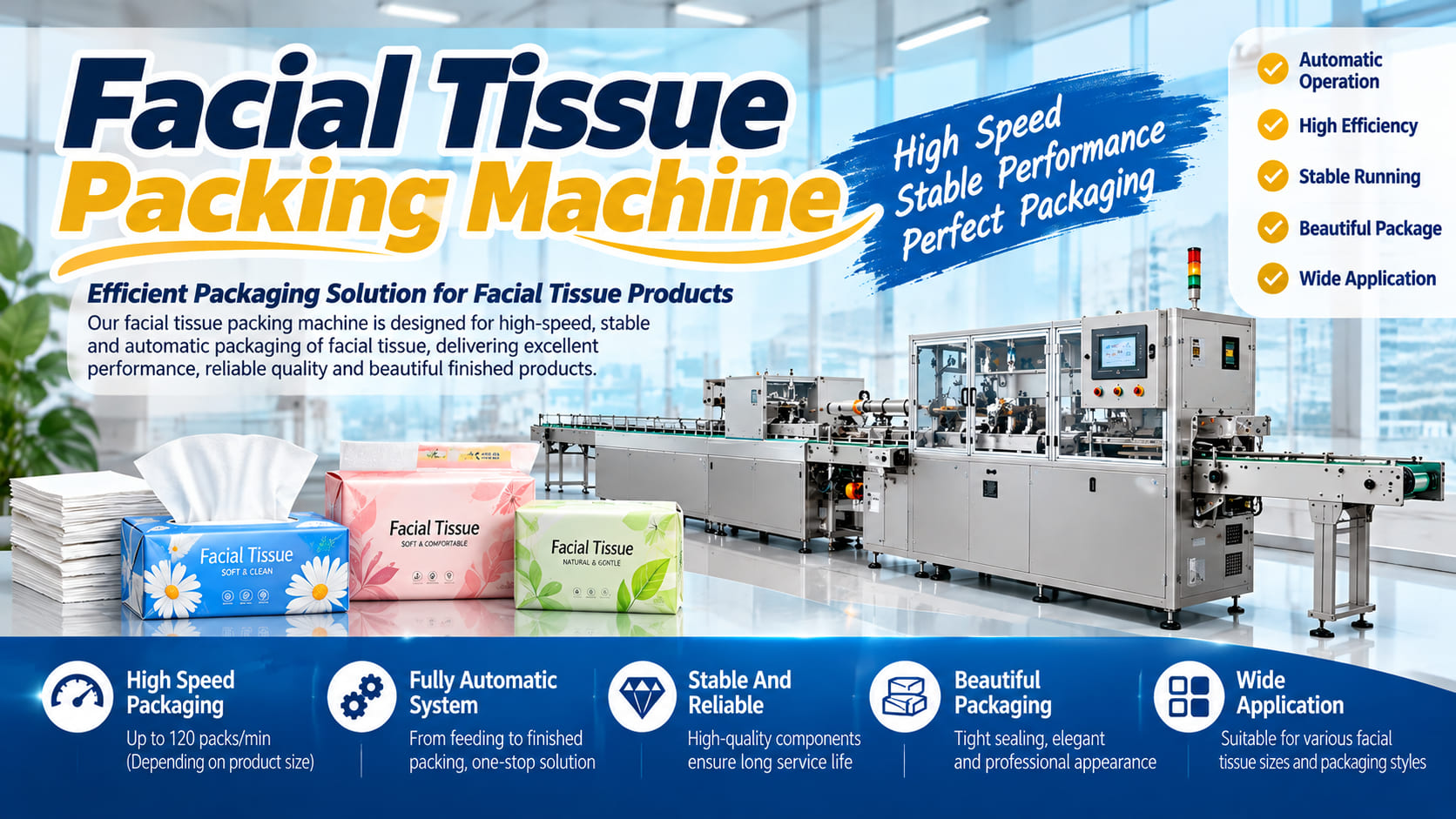
A Facial Tissue Packing Machine is specialized industrial packaging equipment used to prepare folded facial tissue products for distribution, retail display, and consumer use. It receives tissue stacks from an upstream production process or manual feeding station and packages them into the required format using controlled feeding, wrapping, sealing, and discharge mechanisms.
Modern tissue manufacturing requires more than simply producing sheets of paper. Finished products must be protected from contamination, maintain an attractive appearance, and satisfy packaging specifications established by distributors and retailers. A Facial Tissue Packing Machine helps manufacturers achieve these objectives by providing a repeatable packaging process.
Depending on the equipment design, a machine may handle soft-pack facial tissues, individual tissue bundles, or products intended for carton-based packaging. However, not every model supports every packaging style. Manufacturers should distinguish individual soft-pack wrappers from tissue box cartoners, multi-pack bundlers, and complete tissue converting lines.
Main Components of a Facial Tissue Packing Machine
- Automatic feeding system: Transfers finished tissue stacks into the packaging section at a controlled rate.
- Product positioning mechanism: Aligns tissue stacks to help maintain consistent package dimensions.
- Film feeding or packaging supply system: Delivers wrapping film or prepared packaging materials to the product.
- Wrapping and folding mechanism: Shapes the packaging material around the facial tissue stack.
- Heat-sealing system: Produces seals according to packaging material characteristics and machine design.
- PLC and operator interface: Controls operational sequences, parameters, alarms, and production settings.
- Discharge conveyor: Transfers finished packs to inspection, coding, bundling, or case-packing equipment.
Key takeaway: A Facial Tissue Packing Machine is not necessarily the same as a facial tissue folding machine. Folding equipment converts tissue paper into folded stacks, while packaging equipment prepares those stacks for sale and distribution. A complete production line may connect both processes.
Who Uses Facial Tissue Packing Machines?
These machines are commonly used by facial tissue manufacturers, tissue converting factories, contract packaging businesses, private-label tissue suppliers, and companies expanding their consumer paper product operations. They are particularly valuable when production demand exceeds the capacity of manual packaging or when manufacturers require repeatable package dimensions and consistent sealing quality.
Why Do Manufacturers Need a Facial Tissue Packing Machine?
As facial tissue production increases, packaging can become a significant bottleneck. Even when a folding machine produces tissue stacks efficiently, finished products may accumulate if the packaging process cannot keep pace. Choosing an appropriate Facial Tissue Packing Machine helps balance production flow and reduce unnecessary interruptions.
1. Increasing Packaging Productivity
Manual packaging depends heavily on operator availability, individual working speed, and handling consistency. Automated machinery performs repeated packaging operations through synchronized mechanical and electronic controls. This can improve throughput when feeding, packaging materials, and downstream operations are properly matched.
However, actual production speed depends on product dimensions, film properties, changeover frequency, and equipment condition. The maximum advertised machine speed should not be treated as guaranteed daily output.
2. Improving Packaging Consistency
Retail facial tissue packages need predictable dimensions, visually consistent wrapping, and properly formed seals. Irregular packages can create difficulties during bundling, carton packing, palletizing, and retail shelf presentation.
A well-configured Facial Tissue Packing Machine helps control tissue-stack positioning, film alignment, package formation, and sealing parameters. These functions support consistent packaging quality, although regular inspection and appropriate material selection remain necessary.
3. Reducing Manual Handling
Automated feeding and wrapping can reduce the number of times operators must directly handle individual tissue stacks. This is particularly useful for high-volume production lines where manual transfer creates delays or inconsistencies.
Automation does not eliminate the need for trained personnel. Operators are still required for material replenishment, quality checks, machine monitoring, changeovers, cleaning, and maintenance.
4. Supporting Different Packaging Requirements
Facial tissues are sold in different formats, including compact soft packs, family-size packs, boxed tissues, and multi-pack retail bundles. The right equipment configuration allows manufacturers to meet specific product dimensions, sheet counts, packaging designs, and distribution requirements.
When comparing machines, manufacturers should request confirmation of supported formats rather than assuming that one model can accommodate every tissue product.
5. Improving Production Line Integration
A Facial Tissue Packing Machine can be integrated with upstream tissue folding, log cutting, and conveying equipment, as well as downstream coding, bundling, and carton-packing systems. Proper integration helps stabilize material flow and reduces unnecessary product accumulation between processing stages.
How Does a Facial Tissue Packing Machine Work? 5 Essential Steps
The operating sequence of a Facial Tissue Packing Machine depends on the selected packaging technology. For a typical automatic soft-pack wrapping system, the process can be divided into five major stages.
Step 1: Tissue Stack Feeding and Positioning
Finished facial tissue stacks are delivered to the packaging machine through a conveyor or other feeding mechanism. The system positions each stack according to its required orientation and package size. Stable feeding is important because poorly aligned stacks can cause wrapping defects, machine stoppages, and inconsistent finished-package dimensions.
Step 2: Packaging Film Feeding and Registration
The packaging supply system feeds heat-sealable film into the wrapping area. Printed-film applications may use registration sensors to maintain alignment between the printed design and package cutting or sealing positions. Film tension and tracking must be controlled to prevent wrinkles, skewed graphics, and inconsistent package formation.
Step 3: Wrapping and Package Formation
The machine guides the film around each tissue stack using a wrapping or folding mechanism. Accurate positioning helps maintain package appearance without excessive compression of the tissues. The required folding and wrapping sequence depends on the packaging configuration and finished-product design.
Step 4: Heat Sealing and Package Closure
The sealing mechanism closes the wrapping material under controlled temperature, pressure, and contact-time conditions. Appropriate settings depend on the selected film structure. Incorrect parameters may result in weak seals, wrinkles, excessive melting, or film damage. Manufacturers should validate seal integrity with actual packaging materials before continuous production.
Step 5: Finished-Pack Discharge and Inspection
Completed tissue packages leave the machine through a discharge conveyor. Depending on the installed equipment, they may proceed to visual inspection, date coding, automatic rejection, multi-pack bundling, or carton packing. Operators should check package dimensions, film alignment, sealing quality, and visible defects to verify that the production process remains stable.
Important operating consideration: Machine output should be evaluated under actual production conditions, including tissue-stack consistency, film characteristics, production speed, product changeovers, and downstream availability. A machine operating at its maximum mechanical speed may not deliver the same rate of acceptable finished packages.
Facial Tissue Packing Machine Comparison Table: Choosing the Right Equipment
Facial tissue packaging systems differ in automation level, packaging configuration, production capacity, and integration requirements. The following comparison helps buyers identify the equipment category that best matches their production needs.
| Machine Type | Primary Function | Advantages | Best Application |
|---|---|---|---|
| Semi-Automatic Packing Machine | Uses operator assistance for selected feeding or packaging operations. | Lower automation complexity and potentially lower initial investment. | Smaller production facilities and variable-volume operations. |
| Automatic Soft-Pack Wrapping Machine | Wraps folded tissue stacks in flexible packaging film. | Consistent wrapping and integration with tissue conveying systems. | Consumer soft-pack facial tissue production. |
| Facial Tissue Cartoning Machine | Loads folded tissue stacks into prepared or erected cartons. | Supports boxed tissue presentation and carton-based product formats. | Retail tissue boxes and institutional tissue products. |
| Multi-Pack Bundling Machine | Groups individual tissue packs into larger retail or distribution bundles. | Reduces repetitive grouping and supports consistent bundle arrangements. | Bulk retail packs and secondary packaging operations. |
| Integrated Automatic Packing Line | Connects primary packaging with upstream and downstream automation. | Improves coordinated product transfer and reduces handling interruptions. | Medium- and high-volume tissue manufacturing facilities. |
There is no universally suitable Facial Tissue Packing Machine for every manufacturer. Equipment selection should begin with finished-product specifications and required production output rather than automation level alone.
Common Facial Tissue Packing Machine Mistakes and Problems to Avoid
Investing in tissue packaging equipment involves more than comparing quotations and machine speed. Manufacturers can encounter avoidable problems when technical specifications, material compatibility, and production requirements are not clearly established.
1. Choosing a Machine Based Only on Maximum Speed
An advertised maximum speed is typically measured under defined operating conditions. Actual production may be lower because of material replenishment, changeovers, film quality, product feeding, and inspection requirements. Buyers should request demonstrated working output using their intended tissue specifications.
2. Ignoring Packaging Film Compatibility
Different packaging films have different sealing characteristics, thicknesses, stiffness, friction properties, and temperature requirements. Using unsuitable film can cause poor sealing, tracking problems, frequent jams, and excessive material waste. Samples should be tested before confirming equipment specifications.
3. Overlooking Product Size Variations
A machine configured for one tissue-pack format may not support significantly different dimensions without adjustments or replacement parts. Buyers should provide minimum and maximum pack dimensions, tissue thickness, sheet count, and expected product variations during technical evaluation.
4. Neglecting Preventive Maintenance
Packaging machines rely on accurate mechanical movement, sensors, belts, electrical controls, and sealing assemblies. Poor maintenance can contribute to registration errors, inconsistent seals, abnormal vibration, machine stoppages, and premature component wear.
5. Failing to Match Upstream and Downstream Speeds
When tissue folding equipment produces stacks faster than the packaging system can receive them, accumulation may occur. Similarly, slow downstream bundling can restrict the packing machine's effective output. Production lines should be evaluated as connected systems rather than isolated machines.
6. Underestimating Installation Requirements
A Facial Tissue Packing Machine may require a specific electrical supply, compressed-air capacity, conveyor arrangement, maintenance clearance, and operator access. Inadequate factory planning can increase installation complexity and delay commissioning.
7. Ignoring Operator Training and Safety
Operators should understand startup procedures, parameter adjustments, material replacement, emergency stops, and safe jam-clearing procedures. Maintenance involving moving components or heated sealing elements requires appropriate isolation and lockout procedures. Training supports both personnel safety and consistent packaging quality.
Advanced Facial Tissue Packing Machine Techniques and Best Practices
1. Optimize Production Parameters for Each Package Format
Different tissue products may require different settings for conveyor timing, film feed, product compression, sealing temperature, and package dimensions. Where the control system supports parameter recipes, manufacturers can document validated settings for each product format to make changeovers more predictable.
These settings should be verified whenever packaging material specifications or tissue-stack characteristics change. Maintaining accurate records helps operators distinguish normal adjustments from recurring equipment problems.
2. Monitor Real Production Efficiency
Rather than evaluating performance solely by rated packs per minute, track acceptable packs produced, material waste, machine downtime, rejection rates, and average changeover time. These indicators offer a more realistic view of how effectively the Facial Tissue Packing Machine contributes to daily production.
For example, a machine operating at a high instantaneous speed may deliver lower useful output if frequent interruptions occur. Identifying the primary causes of downtime allows maintenance and process improvements to focus on the problems that matter most.
3. Improve Packaging Material Management
Packaging film should be stored and handled according to supplier recommendations to minimize contamination, deformation, and inconsistent processing behavior. Operators should verify film dimensions, roll orientation, printing registration, and sealing specifications before loading a new production batch.
Keeping approved material specifications and sample packages available near the production line can simplify inspection and reduce confusion during material changes.
4. Establish Preventive Maintenance Procedures
A preventive maintenance program should cover conveyor condition, sensor cleanliness, film tracking, sealing-element wear, pneumatic components, electrical connections, and safety interlocks. Maintenance intervals should follow the equipment manufacturer's documentation and actual operating conditions.
Machine guards and safety devices should never be bypassed to maintain production speed. Scheduled maintenance and proper fault diagnosis are more sustainable than repeatedly operating around unresolved defects.
5. Plan for Future Production Expansion
Manufacturers expecting to increase production should assess whether the selected equipment can accommodate additional tissue formats, automated conveyors, coding systems, multi-pack bundling, or case packing. Appropriate capacity planning may prevent costly modifications when production volumes expand.
It is also valuable to confirm spare-parts availability, technical documentation, local electrical compatibility, service arrangements, and operator training before purchasing an industrial packaging system.
Conclusion: How to Select the Right Facial Tissue Packing Machine
A Facial Tissue Packing Machine plays an important role in converting finished tissue stacks into consistent, market-ready products. By automating key packaging operations, the equipment can support productivity, reduce repetitive handling, and improve packaging consistency when properly configured and maintained.
Successful equipment selection depends on matching the machine to the actual production process. Manufacturers should evaluate tissue-pack dimensions, required output, packaging material compatibility, sealing requirements, automation level, factory utilities, and integration with existing production equipment.
The most suitable Facial Tissue Packing Machine is not necessarily the fastest or most expensive model. It is the equipment that consistently delivers the required packaging quality while supporting realistic production volumes, manageable maintenance, and long-term operational needs.
Looking for the Right Facial Tissue Packing Machine?
Before requesting a quotation, prepare your required package length, width, height, sheet count, film type, target packs per minute, and available factory utilities. Include information about existing folding equipment and any required bundling or carton-packing connections.
Contact a qualified tissue packaging equipment supplier to discuss machine configuration, sample testing, production-line compatibility, and a solution tailored to your manufacturing requirements.
Facial Tissue Packing Machine FAQ: Frequently Asked Questions
Q1: What is a Facial Tissue Packing Machine used for?
A Facial Tissue Packing Machine packages folded tissue stacks into protective, consumer-ready units. Depending on the configuration, it performs feeding, positioning, film wrapping, sealing, and discharge operations. It is commonly used in tissue converting factories and facial tissue manufacturing lines to support consistent packaging quality and production efficiency.
Q2: How does an automatic Facial Tissue Packing Machine work?
An automatic Facial Tissue Packing Machine receives folded tissue stacks, aligns them, and feeds packaging material into the wrapping section. The machine forms the package, completes the sealing process, and transfers finished products to downstream equipment. Actual operating sequences vary depending on whether the system uses flexible film, prepared bags, or cartons.
Q3: What is the difference between automatic and semi-automatic tissue packing machines?
Automatic machines perform more packaging operations through integrated controls and material-handling systems. Semi-automatic models require operator involvement in selected steps. The appropriate choice depends on production volume, workforce availability, packaging requirements, factory layout, and available investment rather than automation level alone.
Q4: How many packs per minute can a Facial Tissue Packing Machine produce?
Production capacity varies considerably between machine designs and packaging formats. Actual output depends on tissue dimensions, wrapping materials, feeding stability, sealing requirements, and downstream operations. Buyers should request a demonstrated working speed using their intended products instead of relying only on a maximum advertised speed.
Q5: What packaging materials can a Facial Tissue Packing Machine use?
Depending on machine specifications, facial tissue packaging equipment may process compatible heat-sealable films such as PE, CPP, or other approved film structures. Material thickness, friction characteristics, print registration, and sealing behavior must match the equipment. Compatibility should always be confirmed through supplier specifications and production trials.
Q6: Can one Facial Tissue Packing Machine handle different tissue sizes?
Many machines support a defined range of package dimensions, but their adjustment capability depends on mechanical design and control features. Some product changes require parameter adjustments, tooling changes, or additional components. Manufacturers should confirm the supported size range and changeover procedure before purchasing.
Q7: What causes sealing problems in facial tissue packaging machines?
Common causes include unsuitable sealing temperature, incorrect pressure or contact time, inconsistent film thickness, material contamination, and worn sealing components. Operators should inspect the sealing assembly, verify packaging material specifications, and follow approved machine adjustment procedures to identify and correct the underlying problem.
Q8: How often should a Facial Tissue Packing Machine be maintained?
Maintenance frequency depends on the equipment design, operating hours, packaging materials, and factory environment. Routine checks commonly include sensors, conveyors, sealing elements, pneumatic components, and safety devices. Manufacturers should follow the maintenance schedule provided by the equipment supplier and document recurring operational problems.
Q9: Can a Facial Tissue Packing Machine connect to an existing production line?
Many machines can be integrated with compatible folding, cutting, conveying, bundling, and carton-packing equipment. Successful integration requires confirmation of product dimensions, transfer orientation, conveyor height, production speed, and control interfaces. A technical layout review is recommended before installation.
Q10: What should buyers check before purchasing a Facial Tissue Packing Machine?
Buyers should confirm finished-pack dimensions, production capacity, packaging materials, electrical supply, compressed-air requirements, changeover flexibility, maintenance access, and integration compatibility. It is also important to review sample-test results, spare-parts availability, technical support, operator training, and the supplier's equipment acceptance criteria.
